1 Mar 2022

HSBC Cashback vs Axis Flipkart credit cards

I am a ‘cashback harvester’. I spend way more energy than I should in maximising the credit card cashback I earn. What follows is minutia around cashback policy of 2 credit cards. If such petty details are not your thing, you’ll be better off skipping this post. 🙂
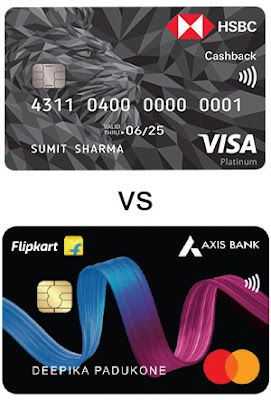
I hold multiple credit cards and I consciously choose the right card to use for every transaction. The ‘right’ card is the one that gives the maximum cashback, of course. Until a few weeks ago, HSBC Cashback card was my default card, primarily because that was the best among what I had (i.e. this is not an objective judgement or recommendation). Then I got Axis Flipkart card and started using the Axis card for everything because it gives me 1.5% cashback on all spends while the HSBC card only gives 1.5% cashback on online spends. But the first statement for my Axis Flipkart card reminded me of the old saying, ‘the devil is in the details’. Let’s look at how the HSBC Cashback card continues to be the better card in some areas.

  • Any spend less than ₹100 will not earn any cashback on the Axis card. The HSBC card doesn’t say anything like it.
  • Cashback on the Flipkart card is rounded down to the nearest whole rupee for each transaction. Doing this for each transaction means the aggregate cashback Axis gives is considerably lower than what one might expect looking at the statement total. For example, I spent ₹181 on the card and that has fetched me ₹2 cashback. One would expect to receive ₹181 × 1.5% = ₹2.715, but will have to forego ₹0.715 because of the rounding down.
This means that I should continue to use the HSBC card for:
  • all online transactions because there’s no rounding down
  • any transaction less than ₹100, be it online or offline

While the HSBC card continues to remain relevant for me, I must also highlight that Axis Bank’s credit card statement makes it very easy to see how much cashback is being earned for each transaction. HSBC doesn’t reveal as much information, so the customer will have to do the math themselves to see if they are getting cashback for every transaction that they think they are getting cashback for.

6 Feb 2022

Compounding of discipline and fitness

Someone I know asked a badminton coach once: “Exercising is boring. How do you keep up the routine to exercise every day?” The coach said, “Yes, it is a bit difficult initially. But once you see your fitness improve as a result of exercising, you feel good. For example, you may not tire as much as before when climbing stairs. Often, that’s enough encouragement to keep going.”

I am experiencing the same thing now, but in financial fitness. For many years, the only “accounting” that I did was reviewing my credit card and bank statements to make sure that there weren’t any surprise charges. Only in 2013—well over a decade after I started making money—I got serious about money management. (The trigger for this came from an unlikely source: Thirukkural!) This is when I started learning about money, investing, etc.

It was a slow start, though. Only in 2019 I decided to write down my expenses as they happened (instead of reviewing once a month). I didn’t have a clear idea of what will come out of this. I was just entering all the expenses into a spreadsheet. Eventually I started making graphs to visualise where my money was going every month. It was all just a futile or fun exercise that didn’t alter my spending choices or money management. I was spending just as before, but now I had a record of where my money was going.

‘Fitness’ by Nick Youngson CC BY-SA 3.0 Pix4free.org

In 2020, I started goal-based investing (thanks to Kuvera!) instead of just putting money in random assets. The combination of expense tracking and structured investing led to another revelation: I must plan for big ticket expenses. Not planning for large expenses was giving me unnecessary financial stress, I realised. More monthly savings and more planning followed.

Until 2 months ago, I couldn’t answer the question “How much is my monthly deficit or surplus”. I could see the list of expenses, but it wasn’t obvious how much I was overspending each month or how much surplus I had left. That led to making one other spreadsheet for monthly budgets. With a budget in place, I now have a good idea of my fiscal discipline at any given time. This is far better than blindly going through the month and meeting expenses as they come up. This budgeting exercise made me realise that I should take some pocket money for myself.

I have a money management system that I keep refining as I go. It keeps getting sophisticated over time! It’s the same thing that the badminton coach said. Once you see some benefits, not only do you continue exercising regularly, you’ll also add more exercising routines, eat better, make changes to improve your sleep, and so on. A good change in one place spills over to neighbouring places and suddenly one day, the change is so massive that it’s overwhelming to a beginner.

If someone had showed to me 10 years ago the same system that I follow today, I would have been overwhelmed and wouldn’t have had the courage to start. Even if I had tried, there’s a good chance I would have failed. The secret is to start small and improve over time. Slow or fast doesn’t matter. Small or big doesn’t matter. But what matters is if you’re doing something that’s sustainable, and if you’re moving in the right direction. Like with compounding, you may not see any change for the first many years. And then, suddenly one day, you’d be witnessing a great change that looks almost unbelievable.

28 Jan 2022

Save family money by taking a monthly allowance for yourself!

Whenever I speak with someone in my family who’s running a business, I tell them to always draw a salary for themselves. I tell them, “Take some money out for yourself every month. If you can’t afford to take ₹10,000 a month, take ₹2,000 a month. But your personal expenses should all come from your own salary. Spending for business needs and personal needs from the same bank account will either lead to excessive spending, and/or confusion about your cash flow.”

As new business owners, they are reluctant to draw a salary for themselves: they feel they should work without a salary until the business is profitable. Taking money out for their personal needs looks selfish to them. But the reality is that they have their own personal expenses, and they often end up spending business capital without realising it.

Picture showing a wallet with money
Image credit: mohamed hassan form PxHere

We always have clarity of thought when we advise others. We conveniently forget or ignore that advice in our own matters. That’s exactly what I was doing too: I was spending family money for my own personal expenses!

I manage money in our household. I take care of cash flow management, saving for recurring expenses (such as insurance premiums, school fees, etc), investing for future needs, and so on. In addition to our main investment portfolio, I also have a “fun portfolio”. The main portfolio is for the family’s needs, so it’s conservative and big in size. The fun portfolio is tiny and has all sorts of random assets that catch my fancy.

Earlier today I was thinking that I should be setting a limit for this fun portfolio. When I was wondering what the limit should be, I realised for the first time that I had been spending family money for my personal expenses (i.e. building this fun portfolio). Oops! I immediately added a certain sum as my allowance to our monthly budget. Whatever personal expense that I have, it must come from that allowance.

Having this arrangement is so liberating. Now I can buy random flashy assets without feeling guilty about splurging family money on random things! It’ll also force me to trim the portfolio by selling some old assets when I want to buy a new asset but I don’t have enough money.

It’s counter-intuitive how taking some money out for my personal expenses ends up saving family money in the long run.

27 Jan 2022

My money management goal for 2022

Ever since I started tracking my expenses in 2019, one thing has been bothering me: I spend more than I earn through regular salary. I am not going broke, though. I have other irregular income too. My total income (salary + irregular) is more than my expenses, so I have some money left over for saving/investing.

This is likely irrational, but I want to spend less than my salary income. Every month I notice that the expenses are more than the salary income, and that stresses me out. As we all know, such a consistent stress is bad for the mind and also bad for the body. And I do notice the impact of this stress.

I don’t know what the solution is. Maybe I can recalibrate the expectations to live within the total income (instead of within the salary income). Maybe I need to come up with a novel way of accounting so that the spending looks healthy. (Reducing expenses is not really an option because I don’t want to downgrade the quality of life.)

I think this is a good money management goal for 2022. What good is money and wealth if you can’t be happy!

25 Dec 2021

How to think about emergency fund

Every sane person I know agrees on this: you should not look for returns from your emergency corpus. “Keep the money in highly liquid forms, such as bank deposits or liquid debt funds; never buy volatile assets with that money,” they advise. I did not understand this advice. “What’s the harm in investing, say 10 to 25% of the corpus in equities?” I thought. The other 75 to 90% is not volatile, so you have access to cash when needed. The exposure to equities will keep your emergency corpus growing at a rapid rate (over a long duration such as 10 years).

This line of thinking led me to put most of my emergency corpus in a hybrid mutual fund. My new financial advisor said that this was a bad idea and asked me to move that money over to liquid funds and bank deposits. “Don’t look for returns from this money,” he said.

Since then, I have been thinking about this. It’s hard for me to do something because “the advisor says so.” I needed a convincing reason for why volatility is a strict no-no. After some thinking, I have come up with an analogy for explaining this.

If your wealth is kept inside a fort, the emergency fund is the wall of that fort and the moat around the wall. Anyone who has been to a fort will know: the walls of a fort are so wide that you can drive cars on them.

External wall of a fortress. Image credit: Dr D S Sinha, licensed under CC0

Imagine you are a king. Your fort also has such strong walls as protection. Maybe you have a moat around the walls too. These walls take up so much space! In all likelihood they also cost significant amount of money to keep in good repair. Now you think about it and say, “The walls and the moat take up a lot of space. What a waste of useful land! Wouldn’t it be better if we used this space for farming or housing?” How would your ministers and advisors respond?

This is exactly the reason for keeping the emergency fund liquid and without volatility. When there is an unforeseen need, you’d burn through your emergency corpus before you start to liquidate your long term assets. The wider the moat and the walls are, the safer your long term assets are. The wider the moat and walls are, the more farming land you give up for the sake of protection.

With this picture in mind, I don’t feel too bad keeping all of my emergency corpus in low-yield nonvolatile assets.