13 Jul 2023

Not all index funds are created equal

The core of my equity portfolio is Vanguard FTSE All-World ETF (VWRA). I wanted to invest in the FTSE Global All-Cap Index through VT, but I had to avoid VT because it is US domiciled. (Reason: The case against investing in US assets.)

While VWRA is a pretty good substitute, at times it felt to me like a compromise. I really wanted to hold as many companies as I can.

A few days ago, I came across the IMID ETF that invests in the MSCI ACWI IMI index. This index is comparable to the FTSE All-Cap index with 9000+ companies from across the world. The ETF is Ireland domiciled. It even charges less expense ratio than VWRA (0.17% vs 0.22%)!

It was a dream come true. Or so it seemed.

I happily announced my discovery to Sayan Sircar, but I was surprised by his lack of enthusiasm. He told me about the “sampling” strategy that some ETFs and index funds use. This helped me dig more and see why IMID was not as amazing as I had thought.

What is “sampling” in ETFs?

The FTSE All-World index has 4163 companies. VWRA, the ETF that tracks this index, holds only 3691 companies. The remaining companies are not “in the sample” that the ETF uses.

VWRA’s portfolio as on 31 May 2023

My jaw dropped when I looked at the holdings of IMID. While the index has 9181 companies in it, the ETF is holding less than 2000 companies! I immediately understood why Sayan was not enthusiastic about this ETF.
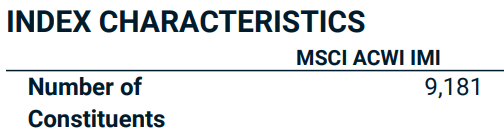
Constituents of the MSCI ACWI IMI index
Holdings of the IMID ETF

I like index funds more because they are passive, and less because they track an index. (See: Not all index investing is passive investing.) An ETF that replicates an index’s performance while holding less than 25% of its constituents is anything but passive. I don’t want such a fund anywhere in my portfolio.

Takeaway

I have learnt this now: Not every index fund fully replicates its underlying index. When choosing an index fund, pay attention to how accurately the fund replicates the index. This is especially important if the index is large and diverse.

11 Jul 2023

The case against investing in US assets

I am a big proponent of global investing, but Indian investors must avoid US assets as much as they can.

I am supportive of buying US stocks as investment assets. In fact, a big chunk of my investment portfolio is US companies. But I recommend against buying those shares directly. If you simply buy US stocks through a US broker (or their Indian partners such as Vested, IndMoney, etc), you’ll be acquiring US domiciled assets. US domiciled assets are bad because they attract US estate tax. ETFs such as VOO and BND are also US domiciled, and should be avoided.

The best way to buy US assets is through instruments that are domiciled in a country that does not collect unfair estate taxes. Any mutual fund sold by Indian AMCs, for example. Ireland domiciled ETFs are another option for those who are comfortable trading in markets outside India.

What is estate tax?

‘Estate tax’ by Nick Youngson CC BY-SA 3.0 Pix4free

Estate tax is the tax some countries collect when a deceased person’s assets are transferred to their legal heirs. If a US resident’s assets are passed to their heirs, assets worth up to 11 million US dollars are transferable without any tax. However, when transferring the assets of nonresident aliens, the US will start collecting taxes at mere 60,000 USD. The tax rate can go up to 40%. My estimation a few months ago was that there will be a tax liability of 3.4 crores INR while transferring a portfolio worth 10 crores INR. To be clear, this is not tax on the gains, but tax on the entire portfolio that is transferred!

But wait, the story gets worse. Even if you accept to pay this unfair tax, the transfer process won’t be quick. My employer has hired a firm to help with such transfers. (If I were to die tomorrow, my family can get assistance from this firm to transfer my assets to their names.) Even with this professional help, they are saying the transfer process can take up to 24 months. While this process is happening, all my US assets will be frozen. My family cannot sell these assets if there was an emergency. Nor can they maintain the portfolio by selling some shares to reduce risk.

My recommendation

Many investment platforms have made US investing extremely easy for Indian investors. While their offerings are great, it is prudent to stay away from them because the US is an unfair and unfriendly place for nonresident aliens like us.

FAQ: I am just 25 and single. Why should I worry about estate tax?

Whenever I talk about estate tax, someone young asks me this. “Why should I worry about estate tax?” The answer I give them is that, “I don’t plan on dying too, but death is inevitable and the time of death unpredictable.”

The main reason people ask this question is that they underestimate the longevity of their investment portfolio. If we are disciplined with investing, our retirement portfolio will last 50 to 80 years or even longer.

Our investment portfolios start small and humble. We don’t expect it to grow to 8 or 9 digit figures. But for most of us, the corpus will grow that big because we’ll be investing for 20, 30, or 40 years. And then we’ll retire and live off of that portfolio for the next 30 or 40 years. Do you want your spouse or your children to pay such a large sum to the US as tax? Especially when there are very good alternatives available, why should we make our families to go through this hassle?

26 Apr 2023

A tracker for short-term mutual fund savings

Jupiter Pots is a service I use for my short-term savings. I also use mutual funds for short-term savings. I thought it’ll be nice if Jupiter Pots supported mutual funds too. Sayan Sircar of Arthgyaan is the kind of person who will inspire you to solve your problems yourself. He gave subtle hints while we were talking that it’s not hard to build something like Jupiter Pots if one wanted. That was enough motivation for me to try making a spreadsheet that does what Jupiter Pots does. Of course the spreadsheet gives a less polished UX (user experience), but it gives us much greater flexibility and control.

After I created the spreadsheet, I humble-bragged to Sayan that I had done it. Then the idea of sharing the spreadsheet to the world through Sayan’s website came. I wrote a blog post with Sayan’s help. He also recommended that we make a demo video, which I think was an excellent idea.

Please head over to Arthgyaan for an overview and demo of my short-term savings tracker.

5 Apr 2023

Liquidity of insurance + investment products

Much before I knew what investing was, I “invested in” an LIC policy. I had the desire to save for the future, but I had no idea what I should be doing. I consulted a friendly LIC agent, and he advised me to get this policy. I bought the policy with my eyes closed. More than a decade later I understood what this policy was like. This is a participating policy, so the investment return is not predetermined.

When I had paid premium for 15 years, I asked an LIC branch to tell me the surrender value of this policy. The policy’s total value came to be over ₹6.46 lakhs. However, if I were to surrender the policy (i.e. abandon the investment), I’ll get just a little bit more than the premium I had paid.

A piece of paper with investment value written by hand

For the corpus value of ₹6,46,875, the growth rate (XIRR) is an impressive 9.52%. But if I couldn’t continue the investment for any reason, I’ll only get ₹3,25,528. Growth rate for that is a measly 0.81%! A return of 0.81% after paying on time every single premium for 15 years straight.

To my surprise, most people seem fine with this. They only look at the 9.5% return, but ignore the lack of liquidity. When discussing liquidity, I ask people this question: “If I have ₹10,00,000 in my PPF account that matures in 5 years, and I need ₹6,00,000 today for a surgery, do I really have that ₹10,00,000?” The answer is No. If you cannot spend the money, you effectively don’t have it.

That’s my main problem with all these insurance + investment products. They give you a good or great return as long as everything goes perfectly as planned. The moment you have to deviate a bit from the original plan, you end up with a big loss. Imagine earning an annualised return of 0.81% on a 15-year investment. That’s as good as gifting money to the insurance company!

If you are considering buying one of these insurance plans with the focus of investing, here is my advice:

  1. Don’t. Liquidity is just one problem. There are many other issues with these products: high cost, low return, insufficient insurance coverage, etc.
  2. If you must buy one, choose a plan that has a short time horizon. A 5-year investment plan is easier to adhere to than a 25-year investment plan. The longer the time duration is, the more you need liquidity and flexibility.

4 Apr 2023

Do TCS deductions reduce advance tax liability?

From 1-Jul-2023, 20% of the LRS amount will be deducted as Tax Collected at Source (TCS) by the bank, and only the remaining 80% will be transferred to the brokerage account. That means, if an investor sends ₹5,00,000 to their brokerage account, they will receive USD worth ₹4,00,000 only! The remaining ₹1,00,000 will be taken away as tax collected at source.

This is a big blow for Indian investors who invest outside India through the LRS scheme. Sure, this is not additional tax. Investors can claim this ₹1,00,000 as tax refund while filing tax return. But there is an opportunity cost as this ₹1,00,000 remains uninvested for up to 15 months (or sometimes even longer).

Can we adjust this TCS with advance tax?

I invest in a Vanguard ETF that is not traded in India. To make this investment, I send money out to a foreign brokerage account through the Liberalised Remittance Scheme (LRS). I was thinking about this new rule, and wondering if there was a way to reduce its impact on me.

I am liable to pay advance tax every quarter as I have regular rent income. I was wondering if the TCS collected at the time of LRS transfers can offset the advance tax I need to pay. Here is an illustration:

  • I send ₹5,00,000 to my brokerage account on 12-Aug-2023. The bank takes out ₹1,00,000 from my remittance and deposits it as income tax into my account.
  • On 15-Sep-2023, I have an advance tax liability of, let’s say, ₹54,000 from other incomes such as rent, capital gains, etc.
  • The question I had was: Can I skip paying the advance tax because the TCS deduction was more than my advance tax liability?

The answer seems to be Yes!

Section 209 of the Income Tax Act, called “Computation of advance tax”, says this:

(1) The amount of advance tax payable by an assessee in the financial year shall […] be computed as follows:
[…]
  (d) the income-tax calculated […] shall […] be reduced by the amount of income-tax which would be deductible or collectible at source during the said financial year under any provision of this Act from any income […]; and the amount of income-tax as so reduced shall be the advance tax payable

It is not the easiest text to follow, but it seems to say that advance tax liability is computed as Advance Tax Payable = Total Tax Payable – (All TCS payments + All TDS payments).

I can skip or reduce my TDS payments based on how much TCS had been deducted in the quarter. That means I’ll have a little bit more capital left with me, which I can invest in India.

The new rule mandating 20% TCS on LRS payments is a big blow for many people. Having rent income has kind-of made it a little bit less severe a hassle for me.
