30 Aug 2023

Direct equity investing is a bumpy ride

We bought a house in February 2023. My original plan was to sell my Google shares to fund the house purchase. I have always had “too much” exposure to Google shares. Selling Google shares to buy the house was a way to reduce the concentration risk. But by the time we finalised a house, the price of Google shares had fallen pretty badly.

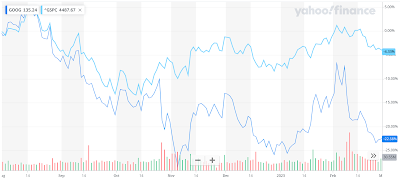
You can see the stark difference between the left half of the following price graph and the right half.
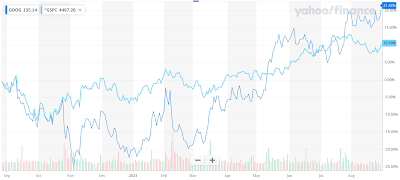
Google share price has appreciated by 21.42% in the last 12 months. But it was in the negative territory for the first 9 months.
Between August 2022 and February 2023, Google share price fell by 22.58%!

When we knew which house we were buying and how much money we needed, Google shares were trading for around $90. I felt it was too low a price to be selling at. I changed the plan and found a different way to raise funds. It felt unnerving when I did that because selling Google shares had always been the plan. Changing the plan in the final weeks is essentially dancing to the tune of the market — something I want to avoid.

$GOOG’s performance since then is nothing short of amazing: almost 50% growth in the last 6 months! It made up for the previous ~20% loss and appreciated further to post a +20% increase year-over-year!

Between March 2023 and September 2023, Google share price grew by 49.47%

Lessons learnt

  • Price swings of 2% or 3% in a day is a regular event. 20% or 50% up/down in a year is also fairly common. Direct equity investors should accept this bumpy ride.
  • What does that mean in practice? You may have heard people advising to not lose hope when the price falls. But the reverse is also true: we should not celebrate if there is a rally and the price is going up. The price can fall any day.
  • Well-diversified mutual funds are a much better alternative for those who don’t like so much volatility. For example when investing towards a financial goal. Directly holding 20+ diversified stocks is not a comparable alternative because deciding how much of what to sell may not be straightforward.
  • Direct equity investors need to be nimble-footed. They should be willing to change plans when needed. It would have been a bummer if I had sold off my Google shares for $90.
  • In addition to having the willingness to alter the plan, a direct equity investor should also have the ability to alter the plan. My situation would have been rough if selling Google shares was the only option.
  • This one I am not so sure about, but… maybe I am better at making investment decisions than I give myself credit for. (Or maybe I just got lucky. What if $GOOG had never recovered? What if $GOOG kept falling?)

15 Aug 2023

Why direct equity investment is hard

Exhibit 1: A fairly well written analysis claims that Sundar Pichai is no visionary: Is there more to Alphabet than Google Search? Quoting from this article:

[Sundar Pichai] has played a significant role in building the core business, which he ran even before taking over as Alphabet’s CEO in 2019. But he is no visionary.

Google developed the Chrome browser, Chrome OS, and Chromebook laptops under Sundar’s leadership. Unless you knew this history — which goes back to late 2000s and early 2010s — it’s very hard to reject this article.

Exhibit 2: An opinion piece that narrates how Chromebooks stole iPad’s market share in a big way: I used to work for Apple and watched it lose the K-12 education market to Google. Now it could lose the next generation of fans. This article doesn’t mention Sundar’s name but it’d be a mistake to assume that Google may have done this all without Sundar’s leadership.

But Chrome is just 1 product line. We also have the benefit of hindsight to say that Chromebooks will continue to compete in the market for a while.

An investor backing Google in the recent past may have had to bet that Google Cloud would turn things around, when it was still making loss after loss every quarter. Investors today will have to believe that Waymo can actually make money when most other self-driving car projects are struggling or being shut down.

Irrespective of how much you know about a company or industry, you’re going to bet blindly at times. Bet blindly a nontrivial portion of your equity portfolio, because otherwise the investment returns don’t move the needle for your wealth. Anyone who cannot do that are better off staying away from direct equity investments.

5 Aug 2023

Which index to invest in? Nifty 50 or Nifty 500?

A popular investment advice is to “invest in a low-cost mutual fund that tracks a diversified index”. There are two parts to this advice.

  • Why index fund? The arithmetic of index investing explains why it makes sense to passively invest in an index rather than trying to take active positions to beat the index.
  • Why low cost? From the point above, we accept that market return is the best we can do. Since mutual funds cost money to run, the lower the cost the higher the return investors can enjoy.

If I want to invest in the Indian share market, what are my options? There isn’t a mutual fund that tracks the entire Indian market. The most popular index is Nifty 50, while broadest investable index is Nifty 500. I am going to compare these 2 with the goal of finding out what we get from each index and what the tradeoffs are.

Diversification

Nifty 50 captures 66% of the Indian market cap, and only contains large cap companies. Nifty 500 captures more than 90% of the Indian market cap, and has large, mid, and small cap companies.

In general, the larger the index the more diversified it is. Any index that does not represent 100% of the market is taking an active position. (See Not all index investing is passive investing.) Nifty 500 is more passive and more diversified than Nifty 50.

Liquidity

While large cap Indian companies see high trading volumes, mid and small cap Indian companies are not traded as frequently. However, according to the NSE index construction methodology, every constituent of both indices must have traded on at least 90% of the days in the assessment period (past 6 months). In other words, both Nifty 50 and Nifty 500 have the same liquidity criteria.

There is no systemic advantage to Nifty 50 here, but in practice, large cap Nifty 50 companies see much greater trading volume than small cap companies. In comparison to Nifty 50, yes, Nifty 500 is at a disadvantage.

Impact cost

Impact cost is inversely proportional to trading volume. Low trading volume, or low liquidity, means that the impact cost is high.

Nifty 50 companies by definition have less impact cost than Nifty 500. According to the index methodologies used, a stock should have an impact cost of 0.5% or less to be included in the Nifty 50 index. Nifty 500 allows impact costs of up to 1%. So in reality and on paper, Nifty 500 has a higher impact cost.

Portfolio churn

Portfolio churn happens in index funds when new companies move into the index to replace an incumbent. When the index constituents change, index funds sell the companies that left the index and buy the ones that entered the index.

It doesn’t always need to happen this way, but the index changes often happen near the bottom of the index. New Nifty 50 companies come from the Nifty Next 50 index; companies that lose their spot in the Nifty 50 index move down to Nifty Next 50. Likewise, for the Nifty 500 index, the companies that enter and leave tend to be small cap companies that take up a small allocation in the index.

Intuitively, we can hypothesise that the impact of the churn can be large in a large cap index that holds only 50 companies compared to an index that holds 500 companies. The churn as a percentage of the market cap is going to be relatively low for the Nifty 500 index while it can be relatively much higher for the Nifty 50 index.

What about tracking error?

Tracking error is a measure of how much an index fund deviates from the index it tracks. It shouldn’t be a surprise that Nifty 50 index funds will have a lower tracking error than Nifty 500 index funds. Why? Because buying and selling 500 companies at the right weights is a lot harder than buying and selling 50 companies at the right weights. The increased impact cost of smaller size companies in the Nifty 500 index will also cause the tracking error to go up.

But tracking error should come into consideration only when there are multiple index funds tracking the same index. In other words, we first pick an index to invest in, and then choose a fund that has the least tracking error historically.

I have seen advice that recommends against investing in large indices like Nifty 500 because they tend to have high tracking errors. In my view, your portfolio companies and diversification are more important than technicalities such as tracking error. There is no need to sacrifice diversification only to get a lower tracking error.

Conclusion

So, what is the better index to invest in? Nifty 50, or Nifty 500? As with most things in finance, there is no one correct answer. Those who care more about cost and liquidity but are okay with a high portfolio churn and less diversification can choose Nifty 50. Those who are okay to pay more in terms of impact cost but prefer a more passive, more diversified portfolio can choose Nifty 500.

30 Jul 2023

Life lesson from an economist

I have been reading The (Mis)Behaviour of Markets, a book that proposes a new way of looking at capital markets.

The author, Benoit B Mandelbrot, is essentially arguing why the older theories are wrong, and how his theories are better. But the amount of detail he has included in the book about how the older ideas were established is incredible.

On page 46, he says this:

“An interest in the history of ideas is good for the scientist’s soul.”

Mandelbrot has spent years working on his ideas and writing this book to replace older theories with his. Yet, he describes the scientists before him with utmost respect.

Isn’t that something we should all learn to do?

Am I coming of age w.r.t. investing?

I was perplexed as a child when I noticed people’s religious behaviours. Everyone around me seemed to believe in a god. They went to temples; they took part in elaborate prayers and rituals. At the same time, they also acted as if god won’t help them. They all acted as if they were on their own. I never understood why.

woman wearing white scoop-neck long-sleeved top over green trees during daytime, photo of people praying
Photo credit: wallpaperflare.com

Fast forward to today. I know 3 people who are proponents of index investing. All 3 of them recommend against active investing such as investing in active mutual funds. However, every one of them is against investing in any NSE index other than Nifty 50!

A basic idea of passive investing is reducing the number of active choices we make. Our active choices don’t always work in our favour, so passive investors voluntarily give up control and let the market decide what they hold. In that view, investing in Nifty 50 is a more active choice than investing in a broader index like Nifty 500. (What do I mean by “active choice”? See Not all index investing is passive investing.) I believe that passive investors should prefer broader indices like Nifty 500.

But no. Contrary to my understanding, no one recommends going beyond the top 50. Take Pattu of freefincal.com for example. He is not enthusiastic about investing in the top 50 companies of the US market. But when it comes to the Indian market, he recommends just the opposite: “avoid going beyond the top 50” is his advice.

According to SEBI's market cap definitions, 75.5% of the Indian equity market cap is large-cap, 15.7% mid-cap, and 8.8% small-cap.
Nifty 50 investors lack exposure to more than 25% of the Indian market cap (image source)

Going back to my confusion about other people’s relationship with god: I eventually learnt to ignore other people’s beliefs and behaviours. These days I only care about my own relationship with god. I am comfortable holding opinions that are not commonly held or doing things that are not commonly done.

I am not as comfortable with investing. Not yet.

I want to invest in Nifty 500, but everyone says “beyond Nifty 50, there be dragons!” I think my hesitation is not about losing money. The 3 people whom I mentioned earlier — I respect these people. I trust their judgement. None of them is enthusiastic about anything beyond Nifty 50. Ignoring their advice and investing in Nifty 500 is a big leap. Big leaps are often scary. Maybe this is a rite of passage that I have to go through to become the independent investor that I want to be.

Update (6-Aug-2023): I wrote a follow-up blog post comparing Nifty 50 and Nifty 500.